Showing posts with label family dinner. Show all posts

Monday, July 7, 2014

Summer Sunday Tradition

A Day In The Life
 
We've been in our new town in North Carolina for just over four months now and we've already got a good Sunday tradition.
 
7-8
We wake up, drink our coffee and see if there's any new updates online. The dogs usually sit with us while we wake up.
 
8-9
Get ready for the day. I usually wear a dress and flats.
 
9-11
We go to church.
 
 
11-1
We have a long talk over Brunch at Bravo. Afterwards we stop by the Home Goods store, to go look for new decorating ideas before we head home. 


1-4
It's especially hot in the Carolinas in the summer, so we head home to relax (soon by our pool), drink sweet tea and see if there's any new updates online.
 
4-7
After the heat has gone down we work outside in the garden. Hubby cuts the lawn while I sweep the step and water the flowers. Afterwards we let the dogs run around to use up some energy.


7-9
This summer while we're remodeling our kitchen we have to eat out. So we go for barbecue or home-style food. I can't wait to get back to making our traditional pork roast. Afterwards, we Skype my in-laws to catch up on our week (They are out West and 3 hours behind).

9-12
Watch our shows. I never seem to get through a whole show, so we oftentimes pause, let the dogs out, then play. We also visit with each pet before bedtime (2 dogs, 3 cats).


Sunday, February 16, 2014

Host A Breakfast Buffet & Try Some New Recipes

Darlings, let's be gracious homemakers today...
 
pretend with me, you're hosting a breakfast buffet for your family, here's some delicious recipes I had to share.


Herbed Frenchtoast with smoked salmon & creme fraiche
...Crumpets...
Crumpets Recipe
Blueberry Buttermilk Pancakes
Poached Eggs
 
So now your family is full, you can graciously carry on your day.
 
Ta-ra darlings!

Saturday, February 15, 2014

Families That Stay Together, Have Family Dinner Together

One way to build a happy family is to put faith and food around your dinner table.
 
"When Jesus sat at the Passover table with his disciples, he instituted the Lord’s supper and said, “I appoint unto you a kingdom that you may eat and drink at my table in my kingdom” (Luke 22:29-30).


I found this article by Connie W. Adams, and it describes how the table of the Lord, can keep a family together;

The Family Table
 
Historically the family table has not only met the physical needs of its members, but has done much to nourish their emotional needs as well. In godly homes, the table has been the place where God is thanked for daily provisions. It has been a place for shared moments for laughter, for concern, for instruction and training and has done much to establish memories which contribute to lasting bonds within a family. “Dinner is ready” has been a welcomed sound to many for a long time.
 
The demands of modern life in our culture have been such that the value (or even presence) of a family table has been diminished. In many a household, families do not eat together. It is difficult to set a time when everyone is present at the same time. Work schedules, school functions, part-time jobs, the desire to eat in a separate room to see something on television, or the notion that “I’ll eat when I am hungry” has interfered with the family table. Many in the present time regard anything which smacks of a routine or schedule as sinister. Forgotten is the fact that family meals are not just to satisfy hunger. They are social events, a time for families to share the same food at the same time, to talk of the events of the day, learn about what happened at work, at school. It is an ideal time for children to listen to their parents and learn something of their heritage. It is a time which ought to challenge every parent to make the occasion special.
 
Ah, but therein lies some of the problem. A family dinner demands, well, a dinner. And who shall prepare it? Whose turn is it to make dinner? The absence of a full-time homemaker in the modem home does create special problems about family meals. It is hard to set a time when everyone can be together. The lack of parental control of children whose whims and boorish manners set the agenda in too many households is a further hindrance to any kind of family dinner time. Parents who allow their children to grow up with picky eating habits deserve whatever grief and embarrassment that may cause them.
 
The Family Table in a Yard Sale
 
I always knew the family dinner table was special but I had it brought home to me in poignant manner which I will never forget. After my mother died in 1995, we decided to have a yard sale to dispose of things we did not intend to keep in the family. It fell the lot of Bobby and me to conduct the yard sale with the help of good folks from the congregation where my mother had attended at Rivermont (Chester), Virginia. We had two days of it and it went fairly well. I have never liked yard sales and some-how the excitement which seems to grip some about them has eluded me. It was distasteful to watch strangers rummage through things which my parents had handled so many times in the course of a lifetime. But I did all right with that until late the second day.
 
We had all decided to sell the old kitchen table and six chairs (we used extra chairs at numerous times). The table was topped with a hard, vinyl-like surface with chrome legs and strips around the top. The chairs had been patched a number of times but were still sturdy and serviceable. Late that day, an older couple came and bought the table and chairs. As they loaded these on a pickup truck, I watched in silence as they hauled it up the hill. And then I had to go in the house for awhile to collect my thoughts and emotions. Through my tears I reflected on a flood of memories all of which had that table right in the middle of them.
 
At that table we learned respect for each other and especially our elders. We had our turns to say what we wanted to say, but we did not interrupt when the “grown folks” were talking. At the family supper table I learned so much about the men with whom my father worked that I felt like I knew them all. From my father and mother we learned much about our heritage. Our grandmother added much spice with her stories of times past. Somehow we felt attached to the people and places of which they spoke so fondly. At that table I learned not to aggravate my brother, at least not in reach of my fathers hand! The only time I remember that he ever physically struck me was over just such an occasion. It startled everyone and scared the living daylights out of me! My father’s method of correction was usually to talk to us in such a way that we felt ashamed of ourselves. His sudden action was totally unexpected, uncharacteristic, and never forgotten.
 
It was at that table, when I was eleven years old, that my parents explained to us why we were leaving the Christian Church, in which we had many relatives and long-time friends. Serious Bible talk made lasting impressions. Somehow, at that table, we were all one family. There we could mourn our losses, savor our victories, commiserate with one another, pass down folk-lore from one generation to another. There at that table the pressures and stresses of the day, of work, school and play, dissolved as we sat down together. The food was not always gourmet, but it was abundant (even in hard times) and lovingly prepared. We did not have the finest china and silverware, but we sure did set the table with love.
 
And now, that table with all its memories had just been hauled away by strangers who could never fully know what memories had been made around it. It was just an inanimate object. Had I known what emotions the selling of it would evoke, it would never have been sold. That inanimate object was the centerpiece of events which had much to do with who we all became and what we have tried to do with our lives.
 
So, amid the rush and press of life as it is lived today, don’t forget the importance of the family dinner table. Take time to eat together, then sit back for a little while and savor the moment and talk to each other. Neglecting the family dinner table will have the same harmful effect on your physical family as neglecting the “table of the Lord” will have on your spiritual family. Do you think it was just an accident that the Lord chose a table as the place to re-member his suffering and to renew our hope for the world to come?
 
- Source
 
 Videos


Family Benefits

Family dinners create a sense of unity and identity, allowing for important traditions and celebrations that make children and adults feel cherished. These meals offer an opportunity to pass along important values and attitudes as well as unique aspects of your family heritage. Shared dinners also provide for regular communication and maintenance of a strong connection. Regular group dinners reinforce the essential parent-child bond. For younger children, group meals teach important conversational tactics, such as patience, listening and respect.

Benefits For Kids

Family dinners allow time for parents to find out about their children's lives and address potential problems. Researchers at North Dakota State University found that the kind of parental monitoring that happens at family mealtime is essential to a child's growth and well-being. Regular meals with loved ones also provide structure and stability in kids' lives, giving them security and setting the groundwork for healthy living in the future. Consistent family meals have been linked to decreased delinquency and substance abuse and better academic performance in children. Shared mealtimes have also been associated with greater levels of personal and social well-being. Family meals are linked to a decreased risk of eating disorders for adolescents, according to the "Journal of Adolescent Health."

Health

Sharing mealtime contributes to the health of the family as a whole. These dinners are a prime time to teach and talk about good eating habits. Parents can describe the nutritive values of foods on the table and explain why well-rounded meals are important. Parents can also monitor children's eating habits to make sure they're meeting nutritional needs for maximum health; children can learn the importance of portion sizes and of understanding when they're full. Regular family dinners have been linked to lower rates of childhood obesity, notes Sean Brotherson, an Extension Family Science specialist and associate professor in the Department of Child Development and Family Science at North Dakota State University.
 

Thursday, February 13, 2014

Nana's Soup and Family History Evening

I'm really looking forward to next week, we'll be closing on our new home and I cannot wait to start decorating and making it homey.
 
Talking of homey, one of my favorite authors is Susan Branch. I've slowly been collecting her recipe books, and have tried out a lot of her recipes. This recipe, Indiana ham and sweet potato soup is the closest one I can find that is just like my Nana's which is a perfect served with freshly made bread rolls for a family history evening.
 
Indiana Ham and Sweet Potato Soup - Susan Branch
 
Despite the snow, and bewildering winter evenings staying at home has given me a lot of extra time to do more of my families history research. It is so important to gather what you already know from your loved ones before they pass, as I have learned.
 
Ancestors
 
My immediate family is a lot smaller now, besides my husband and his family, I have my precious mum and a younger sister. All my grandparents have passed, and my dad died last year at a young age of pancreatic cancer.
 
In our home, we have a new tradition of family history evening. Both my husband and I gather with any family who is here either in person, or simply on the phone to talk about our family history.
 
 Family History Night
 
We talk about our ancestors and their brave or scandalous stories, and sometimes just about our research. But by far, one of the best ways to remember someone is to make one of the family recipes.
 
My Nana' was staunchly British, she could best be described akin to The Dowager Countess of Grantham from Downton Abbey. She upheld very high standards on society and our family, and as a matriarch she was always cooking and always made sure to make enough for everyone, nobody left hungry.
 
So, I can't think of a better way to spend a snow day, indoors, with ham and sweet potato soup reminiscing with family. 
 
I'm linking up with Grace at home #93
and Kelly's Korner

Saturday, July 27, 2013

Secrets to Happy Families

Thought this was a valuable article to share.
 
ByDenise Mann, reviewed by Charlotte E. Grayson Mathis, MD
 
From the Brady Bunch and Partridge Family to the Cleavers, Cunninghams, and Cosbys, images of happy families have rarely been in short supply. We all have ideas about what they should look like.
 
Does yours fit the portrait of a happy family? If not, don't despair. Now we're letting you in on a few of the secrets to a happy family. You, too, can experience some of the domestic bliss that seemed previously reserved just for TV families.

Happy Family Secret No. 1: Enjoy Each Other

The essence of a happy family is that they truly uplift each other and that all comes down to how they treat each other, says Rabbi Shmuley Boteach, a New York-based family and relationship counselor and host of The Learning Channel's Shalom in the Home. "There is a joy that characterizes their interaction," says Boteach, father of eight children and author of several books, including the forthcoming Shalom in the Home. "Parents come home and the kids are happy to see them and when kids come home, the parents are happy to see them."
Cooking with mother

Happy Family Secret No. 2: Swap Stories

"When your kids come home, ask them what happened in school and have a story for them," he says. "If you come home dejected and not really interested and then five minutes later the TV is on, why would they be happy to see you?"
 
The bottom line, he says, is that when you come home, your kids have to come first. "You must drop everything you are doing and always come home with something to share with your kids, whether a story or even the smallest vignette," he says. "This way you give your kids something to look forward to. The great bane of family life is boredom and that is what leads to dysfunction, affairs, and kids wanting to be with their friends over family."
 

Happy Family Secret No. 3: Put the Marriage First

"Set a real example of love," Boteach says. "The relationship and marriage must come first." Think Carol and Mike Brady of the Brady Bunch and Cliff and Clair Huxtable of the Cosby Show.
 
There are many families where kids always come first, says Boteach. Then they become substitute providers of love, he says. "That's an unfair burden to put on a kid." It's also bad for families, he says, "because kids will move out of the house eventually."
.

Happy Family Secret No. 4: Break Bread Together

Families that eat together, stay together. It's that simple. "Family dinners are essential," Boteach says. "It's a time to connect." Have a minimum of four family dinners per week, he suggests.
Norman Rockwell

Happy Family Secret No. 5: Play Together

"Have one or two unifying activities that the family does together on a nightly basis," Boteach says. He suggests bedtime stories for young children or reading a chapter from a novel to an older child.
Sandra Kuck

Happy Family Secret No. 6: Put Family Before Friends

"In happy families, family comes before friends," he says, "The camp counselor understands something that parents don't and that is that caring for kids also has to be fun. Give rules, but understand that kids need fun, too. When kids get bored and listless, they start looking for excitement out of the home and that is when friends become more important. Friendship is important, but subordinate to family."
 

Happy Family Secret No. 7: Limit Children's After-School Activities

Today, growing numbers of kids are over scheduled and participate in six or seven after-school activities per week. The mother becomes a chauffeur and the children are never home at the same time. This is not a recipe for a happy family, Boteach says. "If your kids grow up not knowing how to do ballet, they will be OK. No after-school activities is an extreme and too many activities is the other extreme, but moderation is where we should aim." Create your own after-school activities as a family, he suggests. For example, take your kids rollerblading, bike riding, or swimming after school as a family.
 

Happy Family Secret No. 8: Build and Honor Rituals

"Families need rituals," Boteach says. Rituals can be religious, national, or even family-specific, he says.
 
Barbara Fiese, PhD, professor and chair of psychology at Syracuse University in New York, agrees. "Happy families have meaningful rituals and are not stressed out by them," she says. "They can be unique to your own family such as going for bagels on Saturday morning, a weekly pizza night, or even a family song. Rituals tend to bring family members close together because they are repeated over time."
 
To work, rituals need to be flexible, she adds. "They can't be rigid," Fiese says. "If the bagel place is closed, you have to go someplace else."
vintage summer scene

Happy Family Secret No. 9: Keep Your Voices Down

Remember that children thrive on stability. "There has to be a calm environment at home," says Boteach. "Talk to your kids, give them strict rules, and punish children when necessary, but don't lose control and yell. If you yell at kids, that shows you are out of control and you create a non peaceful environment."
 

Happy Family Secret No. 10: Never Fight in Front of the Kids

TV viewers never really saw Carol and Mike Brady go at it, did they? While some fighting or bickering may be inevitable, try to keep it away from the children, Boteach says. "If your kids see you fight and argue, apologize and say, 'We are sorry you had to see it. Daddy and I just had a disagreement, but everything is OK now.'"
 

Happy Family Secret No. 11: Don't Work Too Much

All work and no play does worse things to a family than make it dull. "If you are away all the time and don't prioritize your kids, your kids will internalize feelings of insecurity," says Boteach. They'll begin to believe that they're not valuable enough.
 

Happy Family Secret No. 12: Encourage Sibling Harmony

Sibling rivalry can be divisive. "I try to speak to my kids about how fortunate they are to have siblings," Boteach says.
Children paintings by Vladimir Volegov

Happy Family Secret No. 13: Have Private Jokes

Happy families have inside jokes, Syracuse's Fiese says, "Jokes and nicknames symbolize that this is a group that you belong to and serves as a shorthand for larger experiences," she says.
 

Happy Family Secret No. 14: Be Flexible

"This is easier said than done," says Fiese. "But by their very nature, families change so you have to be open to change in membership and age," Fiese says. "Somebody gets married, somebody dies, somebody remarries and teenagers are no longer children and young adults are no longer teenagers, but they are all still part of the family."
 

Happy Family Secret No. 15: Communicate

Rose J. Perkins, EdD, associate professor of psychology at Stonehill College in Easton, Mass., says that a happy family communicate with one another. "Frequently families are set up where everyone tells the mom and then the mom sends the message, but in a happy family, there are more flexible, open lines of communication."
 
In happy families, "all the members of family unit are able to communicate openly," she says.
 
Barbecue

Monday, June 3, 2013

Why Storytelling Is Important In A Family

Whether you are from a large family, or small doesn't matter. What matters is the memories you create, the stories you tell, and the legacy you leave behind.
 
Kit
Artist Unknown
 
I'm an avid reader of the dated Marriage and Families Magazine. I'm not Mormon, but I appreciate how important family is to them, and I also like their FHE (Family Home Evening) ideas.
 
This was a well written piece titled:
 
Forging Family Bonds through Storytelling
 
by David C. Dollahite, Ph.D.
 
Storytelling is a very important and a very neglected part of family life. Storytelling is a vital part of family life that we should be more actively involved with, but we tend to be overwhelmed with other, more passive, forms of entertainment, such as television, the Internet, video games, and radio. There are many ways to weave storytelling in your own family, especially as parents tell stories to children and older children tell stories to younger children.
 
The Old Testament speaks of “Elijah the prophet,” and Malachi writes that “he shall turn the heart of the fathers to the children, and the heart of the children to their fathers” (Malachi 4:5-6). There are, no doubt, many layers of meaning to this scripture, but I believe it says, in part, something profoundly important about turning the hearts of family members to one another–about the importance of children knowing their fathers, mothers, grandfathers, grandmothers, and as many other generations as they can know.
 
I have both thought about and studied what causes the hearts within a family to turn toward each other, and I’ve come to the conclusion that one of the most powerful forces is the telling of stories within our families. And I believe that developing a tradition of storytelling as an intentional part of a family’s daily, weekly, and monthly family activities will help touch and turn parents’ hearts to their children and the children’s hearts toward the parents.
 

What is family storytelling?

Family storytelling is as simple as family members telling stories to one another. There are many narratives from myths, tall tales, or other literature. Most people know and tell these existing stories, or they may read them in books. Sharing these stories is fine, but it is also beneficial to tell your children stories that mean something to you personally. Children love to hear their parents tell stories about themselves, especially about when they were young since this helps children feel closer to their bigger, older parent.
 
Family storytelling also grows out of the growing worldwide interest in genealogy and family history. Some people do not realize that an important part of genealogy is sharing and preserving the memories of family members who are living, as well as the histories of our ancestors. In every extended family, there seems to be at least one person who is concerned with genealogical work, while the rest of the family members usually go about doing their own thing. We need, instead, to have each living family member share their stories with other living family members. That is one of the keys to ensuring that a family isn’t just a bunch of people living in the same house, sharing the same smelling food, and having conversations mainly about mundane things. If you keep a personal history already, then you have a wealth of information that you can impart to your children.
 
There is an old Hasidic Jewish saying that states, “Give people a fact, and you enlighten their minds; tell them a story, and you touch their souls.” To have an enlightened mind is a good thing, but it is also good to have an enlightened soul. “Turning hearts” through storytelling creates a sense of oneness and connection between family members and generations that is quite different than parents and children who simply feel they are related by blood and the fact that they live under the same roof. Instead, they become connected by a love that grows out of knowing and understanding each other and feeling committed to each other.
 

Why is storytelling important?

Most people feel quite close to their mothers. On the other hand, many people have a bit of ambivalence toward their fathers and may not feel as close to them. This maybe because the father is away a lot or he works long hours. It may also be that he just doesn’t share much of himself, because many men do not verbalize their feelings or connect emotionally to their kids as much as their kids would like them to. When I ask students to share a story showing the connection they feel with their mothers, it is sometimes difficult for them to identify a particular experience because the connection is often ongoing and seamless. When I ask students to share the same kind of story about their fathers, most can identify a story about a time when they felt especially connected to their fathers. Often, the story centers around an illness or accident the student or their father has had.
 
When I was teaching at the University of North Carolina, I asked students to tell me a story of when they felt close to their fathers. A young woman in my class named Megan remembered that experience as a time when her father went the extra mile and sacrificed and in some ways put his life at risk to do something he knew was important to her.
 
Each year for her birthday, Megan’s father came to her grammar school for lunch. He would bring Megan and her friends ice cream sandwiches, and they would put candles in them and then sing “Happy Birthday.” He did this in grades 1 through 5 and this became a very important tradition for Megan. When Megan was in the sixth grade, she was especially looking forward to her father coming, assuming it would be the last time he did this. Just a couple of days before her birthday, Megan came home from school and found a note on the refrigerator. It was from her mother, who explained that her father had had another heart attack, that he was going to be okay, but that he was going to have to be in the hospital for several days. Megan, of course, was grateful her father was alive, but she also realized he wouldn’t be there for her birthday. When she woke up on the morning of her birthday with her father still in the hospital she did not want to get out of bed, let alone go to school. But her mother told her she needed to go, so she did, but she spent the entire morning dreading lunchtime. When the lunch bell finally rang, Megan stayed behind in her classroom while everyone else ran off to lunch. Eventually, she made it down the hall to the lunchroom, and there, sitting in a wheelchair with an I.V. in his arm, was her father. She ran over to him, saying, “Daddy, what are you doing here? You’re not supposed to be here!” Grinning, Megan’s father said, “It’s your birthday, isn’t it? I wouldn’t be anywhere in the world but here with you.”
  
I’d like you to think for a moment about your reactions to the first part of this article–before I shared the story about Megan and her father. Then compare that to your reaction to this story. If you are like most people, your reaction to the story was quite different than your reaction to the “ideas” I had been sharing about storytelling. You probably perked up just a little when I indicated I was going to share a story, and you probably paid a little more attention to what was being said. Megan’s illustration of family closeness put some flesh on what was initially just me giving you my opinion. It probably prompted you to use more than just your intellect to understand; you used your emotions as well.
 
The story also may have been motivating. Someone hearing this story might think “Hmmm, I could do something like that for my kids,” or “I can see why developing a pattern like that could be really important to my kids.” Especially men who did not have a strong father figure in their lives may feel some extra motivation to be a good father, and they may also come away from it with a concrete idea they could use in their own lives. A story sinks in, and we remember it. I have told this story about the young woman and her father many times to many groups of people, and I can’t help but feel emotional whenever I tell it and I know that others are also experiencing strong emotion for various reasons. Stories can have the effect of helping us remember an idea, a feeling, or a principle far better than if it is simply presented as an abstract concept.
 
Families and stories are very much intertwined. From birth to death, we are surrounded and nurtured by family members and the stories they tell. Your parents may tell you stories that parallel your own experiences, or your older siblings may have told you stories about when they were your age. The relationships we have with people are largely influenced by our shared experiences, which are most often and most effectively shared through stories. Once a family goes on a vacation or has an experience like a fire in the kitchen, that event becomes part of the family’s canon of stories, and it gets retold again and again. When children beg for a bedtime story, they are not just trying to avoid the inevitable, they are demonstrating, to borrow from the words of Jesus, that they do not live by bread alone. In addition to the food and shelter parents provide, children need the emotional, relational sustenance they get from the stories in the family’s own unique anthology of stories.
 

Why is storytelling so powerful?

If you’re not convinced that stories are powerful, consider how many of us spend the majority of our leisure time. We watch television, where, if we think at all actively, we can figure out how a story likely will end three minutes into the show. Or we skip reading our classroom assignments in favor of reading a novel. Yet because we like and need stories so much, we will continue watching even dumb shows or reading a novel even when we have more important things to do. If even silly or predictable stories keep busy adults glued to them, think how powerful are good stories told by people we love. Think of what we really want to hear when we talk with our friends about their most recent date or adventure– we want to hear “a good story.”
 
Much of storytelling today is a seamless part of day-to-day life, compared to life in the “old days,” when people would spend the day working and then gather as a family in the evenings to tell stories. There were even those bards who would travel from village to village telling stories, a tradition that has been replaced in our modern times by much more readily available– and yet far more passive– forms of entertainment. We still have stories, but we are now largely unconnected to them since they are told by professionals we do not know and who do not know or care about us. Thus, we don’t talk to each other enough and forge the strong emotional connections that sharing stories and experiences provide.
 
The stories our children crave are about life as it is lived. They have surprise twists, heroes, and action. Stories capture the essence of life. They often involve a change of heart. They give the best examples we have of how to change and why to change.
 
If you are at all reluctant about sharing your stories with your children, think about the greatest teachers you know or speakers you have heard. Your joy in their words probably comes, in large part, from their excellent storytelling. You, as a listener, remember stories more than you remember abstract ideas. This phenomenon has been documented. Most people remember a simple story better than they remember a theoretical abstraction of a great philosophy.
What kinds of stories should be told in families?
  
The stories we tell can be about anything. They can be fairytales, myths, or tall tales. They can be about Cinderella or the Three Bears. These are universal stories, and children love hearing them from their parents, especially if parents make the story their own by using different voices, gestures, motions, acting out the story, or other creative approaches. For example, it is one thing to tell your three-year old the story of Jonah and the Whale and another thing to “swallow” them up in your arms and then “vomit” them out onto the beach at Nineveh (the floor or a couch) at that point in the story. Finding ways to tell familiar stories in new and creative ways is important to help your children have those stories come alive and stay alive to them.
 
We can also make up stories. Like many, I make up stories and tell my children stories where they are the heroes and heroines. The names in the stories are either the exact names or names similar to theirs and the characters in the stories do brave, honest, kind, creative, and fun things. Making up stories where the children are the heroes can not only be very entertaining for them, but they can be inspirational as well. Another thing you can do is a round-robin activity, where one person starts the story and then stops and points to another family member who continues the story. If you have children who can really to get involved in this, they can be very creative–and you can have a lot more fun as a family than you can with a story that comes from a store.
 
Your children want to hear stories about when you were young, about experiences you had in school when you were their age, about how you and your spouse met, and about other significant–or even nonsignificant– events in your life. While parents should tell stories about themselves, they can also tell stories about their ancestors. Your children should know about grandma’s experience in immigrating to the United States, and about the character traits of their predecessors.
 
One story I often tell is about my father. He was a police officer for 17 years in our hometown during a time when there were a lot of problems with drugs, riots, and violence. And, somehow, our town was a kind of Mecca for these problems. I knew, as a boy, that he was out dealing with the “bad guys” and putting his life in danger, but one night that reality came home in a very powerful way. I was 12, and my best friend was over, having dinner with my family. Our house was on a busy street, and it was not uncommon to hear a car backfire. And, sure enough, while we were eating we heard what sounded like a car backfiring. But then we heard someone scream, “Help, I’ve been hit! I’ve been hit! Please help me!” Before my friend and I even realized someone had been shot, my father, who wasn’t on duty, ran into his bedroom, grabbed his gun, and ran out the door.
 
Of course, my friend and I thought this was really cool, so we ran to the front window to watch my dad go after the bad guys. My mom, however, had a different reaction, and she pulled us away from the window, pulled down the shade, locked the front door, and made us go into the back of the house. And then she just sat there and literally shook and shivered until my dad came home. That’s the first time I really realized that my dad was a hero. But I also realized, for the first time, what my mom had to live with every day, as her husband went off each day and put his life in danger.
 
My father now lives with us, and my telling this story helps my children appreciate the old guy who sits by them at the dinner table and gives them candy in a very different way than they would without that story. Now they think, “Wow, Papa was a real hero.” It is one way I turn the hearts of my children to my father.
 
We should also tell stories from family’s ethnic, national, or cultural background. I often tell my children about their great grandfather Iver from Norway, who had a very exciting life. He escaped death numerous times; in fact, he came into the port of Birmingham about two weeks after the Titanic set sail, and was hired as a merchant marine on the next major ship to set sail from that port.
 
After he immigrated to the United States, he worked as a logger in Minnesota and lived in a small cabin in the woods. Each day, he would go home for lunch, and one of his coworkers started coming over everyday as well, which disturbed Grandpa Iver because he was, by nature, a private person. He wanted his coworker to stop coming, but he was uncomfortable with confronting the man directly, so he had to use his wits. So the next time this man came over, Grandpa Iver took the plates off the table after they had finished lunch, put them on the floor, and allowed his dog to lick them clean. Grandpa Iver then put the plates back into the cupboard, and the man never came back for lunch. My kids love this story and it helps turn their hearts to their great grandfather who they never knew personally. We should also share stories that grow out of our religious beliefs and our faith. These stories may come from the Bible or other books we hold sacred, or they may come from our own experiences. If you believe in Jesus Christ, then you should talk about him more often than just during Christmastime. If we want to perpetuate our faith among our children, we need to share these sacred stories so that they will understand why we subscribe to a particular set of religious tenets. Our children deserve to hear more than once the story of how we came to know, believe in, and accept our most deeply cherished spiritual principles.
 
Now, a word of caution. Do not tell stories at the expense of other family members. It affects a family member if he or she becomes the brunt of unkind– even if humorous–family stories. As a parent, if you notice that one of your children is the target of hurtful stories, encourage your children to aim the stories in a new direction. You are the only one who can tell embarrassing stories about yourself. No one else should be able to do so, if it causes hurt feelings.  
 

When is the best time to tell family stories?

Anytime, all the time. Have this be an important activity that they will remember when they are older. Consider these possibilities:
  • At dinnertime: We have a tradition that when someone comes for dinner, we have to earn our dessert by sometime during the meal each person telling a story. In many families during a meal, one person or two tend to dominate the conversation, so this is a way to get all of the family members and the guests involved in the conversation. My family also likes to talk about dreams during meals. My children frequently ask me to tell them about my dreams because I have all kinds of crazy adventures when I am asleep and I love to ask my kids about their dreams as a window on their inner experience. Find creative ways to prolong mealtime since it is one of the best times to share stories in a relaxed atmosphere. 
  • At bedtime: Kids are very receptive at bedtime. They are relaxed. They have had dinner. They are feeling comfortable and warm. What you tell them will stick with them. Don’t spend this time telling them just about the Three Bears. Tell them the things of your soul and the stories that you most want them to remember and sink into their souls.
  • In the car: Most families have travel routines or games they play. You can also make stories, especially traveling stories, part of your time in the car. You can even have stories on tape. Nowadays, the television has ended up in many of our cars, and while that can help the time pass on a long trip, we need to do in the car what we do in our homes: as often as possible turn off the TV and tell each other stories.   
  • While working: When you are working together side-byside it is a great time to talk about when you were young. Telling stories can actually make the task less tedious for all involved. Your family may actually look forward to work if they know they are going to get to hear mom and dad tell good stories.

Saturday, October 15, 2011

Oldie humor and Darn it

Well, surprise surprise!

Guess who hasn't blogged on her blog in awhile? Well ahem...I'm not standing up any time soon.

Life has been interesting. Juggling to-do's seem to be a constant and decorating is an ever evolving project, balanced by effort and spare pennies we've found, you know...in the piggy bank.

This morning I couldn't get up at all, even with a cup of coffee, a slither of danish pastry and well buttered toast besided me. I'm seriously wondering if I'm getting old, or if my body has a do not disturb clock.

9:20am rolled around and finally I got ready for my day. We headed to one of Cory's friends parents house so her younger brother could fix the brakes...

...but life, being life Cory forgot some papers at home on his way. So, I had to park my car, hop into his and go back home to pick up the darned paperwork...and then we were back on track.

After dropping off the car, we headed in my car to Cory's accountant to scratch some numbers. I waited in the lobby, reading the paper inserts for Jo-Ann's wondering if I should sneak the coupons or not. I didn't.

Hush!

No, really I didn't.

Then we headed to Tuesday Morning's in search of something, nothing in particular. All we saw was aisle after aisle of Christmas decor. Oh, I had to get some damask paper napkins for the Fall, for special occasions of course {We use damask cloth napkins for day-to-day life}.

Then onto lunch at Azteca to share some delicious chicken fajitas...

After lunch, we headed to Pier 1 and home. I finally got Cory to put up our finial tie backs, found on sale at BB&B for $4 a pair...they look great, and our room is getting there, lot's still to do though.

Okay, off to dinner..and I'll leave you in suspense to find out where!

Oh, I almost forgot to share this funny website called 'The Problem With Young People Today Is'

Wednesday, July 8, 2009

Father Of The Bride I

Have you ever dreamed of living in the Father of the Bride home? Ever since I was a child I dreamed of laying in the hammock in their backyard, and joining the family for their family dinner.
 
You can watch the movie here...
 
Here's Wikipedia's synopsis on this movie favorite from 1991.
 
"George Banks (Steve Martin) is an upper-middle-class owner of an athletic shoe company in San Marino, California, whose 22-year-old daughter, Annie, (Kimberly Williams) has decided to marry Bryan MacKenzie (George Newbern), a man from an upper-class family from Bel-Air, despite only knowing each other for three months. George can’t think of what life would be like without Annie and becomes determined to make the upcoming ceremony as inconvenient as possible (especially when he finds out the wedding will cost him $250 per head), although his wife, Nina (Diane Keaton), tries to make him happy for Annie. When the wedding takes place at their home, along with an eccentric wedding planner named Franck (Martin Short) taking over the ceremony, George tries to handle the fact that Annie has grown up and has a life of her own."
 
 
 Father of the Bride House Exterio
 
The home located is located on Maple Drive and what 1990's movie doesn't start without a bike riding by? It looks idyllic with the white picket fence and charming green shutters.
 
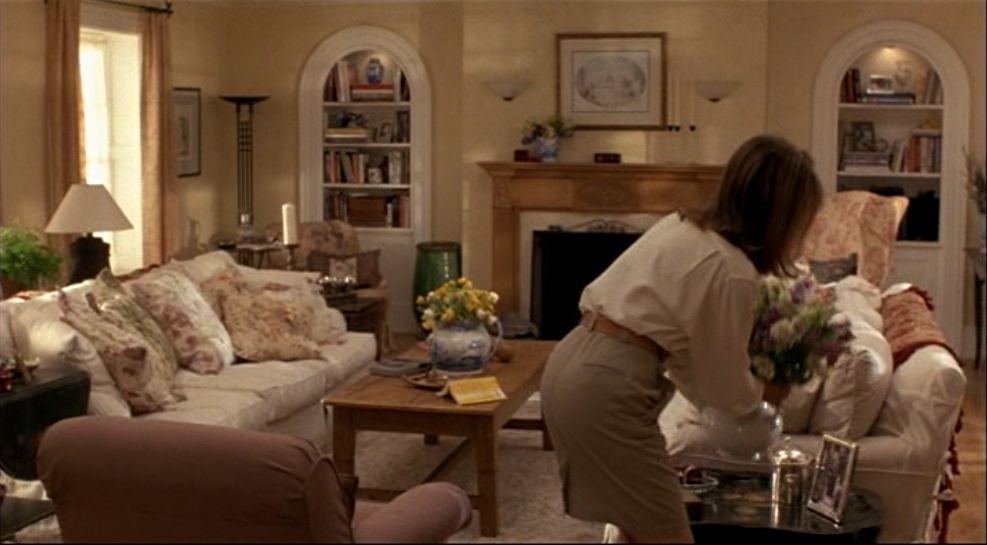
To the left as you enter the Banks' home is their living room. It is a mixture of formal with it's focal points and furniture arrangements, yet informal with it's materials. I just love the creamy butter walls throughout and the crisp white trim.
 
 
Father of the Bride Movie House


Tour the Father of the Bride Movie House

 Tour the Father of the Bride Wedding Scene

Opposite to the living room is a picture perfect dining room. The French provincial table and chairs, make this home feel informal, yet full of character. It's as if the set designers wanted us to feel comfortable within their home as we watch some of the Banks most precious moments.
 
 
Father of the Bride dining room
 
Nina Banks in her kitchen, which if appliances were changed is timeless. The dining room is set behind the double glass doors. Below you can also see the breakfast table where they sit informally to look at wedding invites.
 
Father of the Bride Movie House Kitchen
 
Tour the Father of the Bride Movie House
 
Let's go look at George and Nina's bedroom. Notice throughout the house almost all the pictures are floral which creates a sense of unity between all the rooms. The bed side tables are different too, creating a sense of different personalities, done in most set homes.
 
Tour the Father of the Bride Movie House
 
Annie sitting on the back porch. Her dad comes outside to talk with her, and apologize. The basketball hoop in the background also symbolizes her childhood, and spending time with her dad.
 
Father of the Bride movie house-patio
 
The proud father and daughter walking down the aisle.
 
 
What a 1990's classic movie.
Print Friendly and PDF
Related Posts Plugin for WordPress, Blogger...